
RECOMMENDED PRODUCTS


“Market Manipulation” Series (Part 1): Thematic Concepts Carry Risks; Chasing Downsides and Buying Upsides Can Easily Lead to Being Trapped

Source: Shenzhen Stock Exchange Investor Education Center
Some individual investors share a common frustration when trading stocks: after buying shares that have been on a strong upward trend, the price invariably falls, and they always end up taking the last hit. Why is it always them who get hurt? Judging from several cases of illegal activity, this often stems from a lack of fundamental analysis—investors rely solely on chart patterns and gut feelings, inadvertently purchasing stocks whose prices have been artificially inflated by unlawful actors, only to find themselves trapped at high levels. Below, we’ll illustrate this with an example:
From February 12 to March 23, 2015—over just 23 trading days—the C‑shares on the ChiNext board surged 55.1%, while the ChiNext Index rose 20.93% over the same period, yielding a divergence of 34.17%. In less than a month, investors reaped returns exceeding 30%, underscoring how swiftly the stock market can deliver strong gains. What factors drove such exceptional stock‑price performance, and what lies behind this remarkable move?
The stock’s fundamentals have not changed significantly.
Based on announcements released over a 23‑trading‑day period, there were two positive developments for Stock C: First, on February 28, 2015, the company issued a preliminary report on its 2014 results, showing net profit growth of 176.74%, though the absolute figure was only RMB 60 million—while the average net profit of ChiNext‑listed companies in 2014 stood at RMB 94 million. Second, on March 18, 2015, the company announced a 2014 profit‑distribution plan, under which the actual controller proposed a cash dividend of RMB 0.8 per 10 shares (tax inclusive) and a share capitalization of 10 new shares for every 10 held. According to statistics, more than 90 ChiNext‑listed firms have proposed a 10‑for‑10 stock split, with several even opting for 10‑for‑20 or 10‑for‑15 splits. From a horizontal comparative perspective among listed companies, these two announcements appear relatively unremarkable.
In fact, C stock had already surged well before the aforementioned announcement, as evidenced by numerous eye-catching media headlines: “Internet Finance Concept Soars Again—C Posts Three Consecutive Limit-Ups” (February 12, 2015) and “Internet‑Related Stocks Subject to Wild Speculation as Institutions Engage in Fierce Long–Short Battles” (February 16, 2015).
The penalty imposed on the violator sheds light on the reasons behind the sharp rise.
The fundamentals of C‑stock are not particularly strong—so is it being driven by hype alone? Is the share price rally the result of investors uncovering intrinsic value, or is it fueled by the incitement and manipulation of market manipulators?
In March 2017, the China Securities Regulatory Commission publicly issued an Administrative Penalty Decision that revealed the reasons behind the sharp rise in C’s stock price. It turned out that illegal entities controlling substantial funds, in collusion with their relatives and friends, used multiple accounts to manipulate the stock price, steadily driving it higher before selling at elevated levels and pocketing profits of as much as RMB 200 million. The methods employed by these unlawful actors to manipulate the stock price included:
1. Using controlled accounts to engage in wash trading and reverse transactions, thereby artificially inflating trading volume;
2. After submitting an order, a large proportion of the orders are canceled to create false trading activity;
3. Pump up the stock price, create a speculative hype, lure investors into chasing higher prices, and then sell to lock in profits.
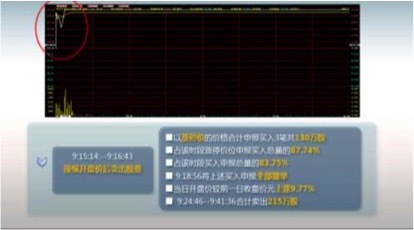
Take March 23, 2015, as an example: the relevant accounts leveraged their financial strength to engineer an upward opening price trend, luring other investors to follow and buy. Shortly after the market opened, the stock was immediately locked at the daily upper limit, while the perpetrators promptly sold off their entire holdings, exiting the position with substantial profits. The day’s price action and manipulation are illustrated in the chart below.
Manipulating stock prices will not escape the law.
The Securities Law explicitly prohibits the use of financial strength, shareholding advantages, or informational advantages to engage in concerted or continuous trading aimed at manipulating security prices or trading volumes. This case underscores that investors must strictly comply with securities laws and regulations, as well as exchange‑specific trading rules, when participating in securities transactions, so as to avoid actions that could disrupt market price and volume dynamics. The law’s reach is comprehensive and leaves no loophole; securities regulators maintain a stringent enforcement stance against illegal and non‑compliant conduct. Intentional manipulation of stock prices will inevitably be subject to severe legal penalties; in this case, the violators not only had their illicit gains of RMB 200 million confiscated but also were fined an additional RMB 600 million.
On the other hand, if investors fail to engage in independent, in-depth analysis of a stock’s fundamentals and instead chase higher prices based solely on thematic narratives or sudden rallies, they are highly likely to fall victim to market manipulation by unlawful actors. To avoid becoming unwitting “bagholders” at inflated price levels, investors should exercise careful discernment, think critically, and make well-considered decisions when trading stocks.
(Disclaimer: The information provided in this column does not constitute any investment advice. Investors should not rely on such information in lieu of their own independent judgment or make decisions solely based on it. While the contributors strive to ensure the accuracy and reliability of the information presented in this column, no warranty is given as to its accuracy, completeness, or timeliness, and no liability is assumed for any losses arising from the use of such information.)
Key words: