
RECOMMENDED PRODUCTS


“Market Manipulation” Series (Part 4): Trend Creation Holds Hidden Tricks—Don’t Place Blind Faith in Limit-Up Stocks

【 “Investor Protection: Understand the Rules, Recognize the Risks” ” system List】
Source: Shenzhen Stock Exchange Investor Education Center
Many people are eager to share this “investment wisdom” with their family and friends: when a stock hits the daily upper limit at the close, it signals strong market demand, making it highly likely to continue rising in the next trading session. Moreover, the greater the volume of buy orders left at the limit‑up price that remain unfilled at the close, the higher the probability of further gains the following day—sometimes even triggering consecutive days of limit‑up rallies. Some investors, guided by such advice, pour substantial resources and effort into chasing stocks that have reached the upper limit. But do limit‑up stocks really offer a reliable source of steady returns?
Recently, the China Securities Regulatory Commission’s enforcement cases have revealed a market manipulation scheme in which unlawful actors exploit investors’ blind faith in stocks that have hit their daily upper limit, creating an artificial upward price trend to reap substantial profits. The key steps involved include:
l Steadily building positions in relevant stocks;
l Deliberately guiding the stock price to near or reach the daily upper limit;
l Continuing to place large, high‑volume buy orders at the daily price limit, despite knowing that the probability of execution is very low;
l After achieving the goal of attracting other investors to buy, they take the opportunity to sell at a high price and lock in profits.
The specific details of the case are as follows:
Ma XX and Cao XX are the respective heads of W Investment Company and S Private Equity Fund, which share the same office premises. Together, Ma XX and Cao XX controlled a total of 38 individual and trust accounts (hereinafter referred to as the “account group”) and conspired to manipulate the share price of Stock A for profit.
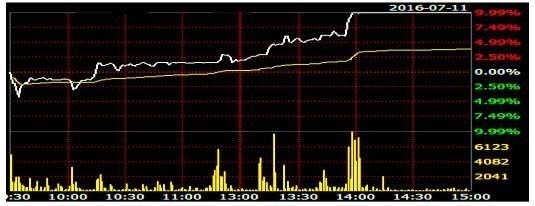
From July 5 to July 12, 2016, the account group engaged in a price‑pumping and accumulation phase for Stock A. Between July 5 and 8, the stock price remained relatively stable, during which the group collectively purchased 9.0059 million shares of Stock A. On July 11, the group began to engineer a limit‑up move: from 14:03:18 to 14:06:13, after driving the price to the daily upper limit, they continued to place buy orders at that limit price, submitting a total of 29 orders amounting to 6.0093 million shares. By the close of trading that day, the group’s outstanding limit‑up buy orders totaled 5.7486 million shares, accounting for 51.73% of all such pending orders across the entire market. The stock’s price action on July 11 is illustrated in the chart below.
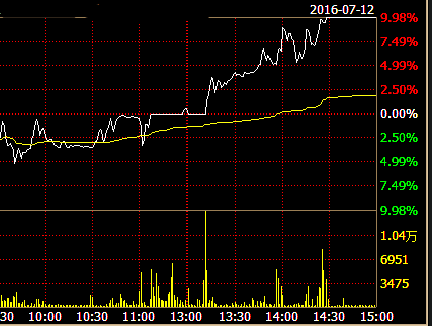
On July 12, the account group replicated the trading strategy employed on July 11: between 14:29:13 and 14:32:34, they drove the stock price up to the daily limit-up and then continued to place buy orders at that limit‑up price, submitting a total of 23 buy orders amounting to 5.0986 million shares. By the close of trading that day, the group’s outstanding limit‑up buy orders totaled 3.9363 million shares, accounting for 49.14% of all such pending limit‑up buy orders across the entire market. Slightly different from July 11, on July 12 the group began unwinding its position during the price‑pumping phase, netting 1.9116 million shares sold that day. The stock’s price action on July 12 is shown in the chart below.
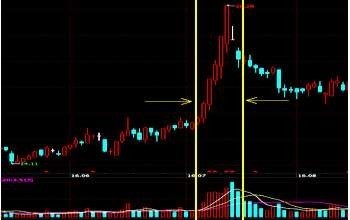
On July 13 and 14, Stock A was suspended from trading due to abnormal price fluctuations. On July 15… On the day trading resumed, the stock hit the daily limit down, and the account group sold off its holdings for that day. 94.73%; the holding was reduced from 10.4385 million shares to 486,900 shares. On July 18, the account group liquidated its entire position, and the stock price fell by 6.48%. Between July 5 and July 18, 2016—over just eight trading days—the stock exhibited a sharp surge followed by a steep decline; see the chart below.
Article 77 of the Securities Law prohibits market manipulation and enumerates four specific manipulative practices. In this case, Ma XX and Cao XX violated provisions set forth in paragraph 1, items (1), (3), and (4), namely: “individually or through collusion, leveraging financial strength, shareholding advantages, or informational advantages to engage in joint or consecutive trading, thereby manipulating the price or volume of securities transactions”; “conducting securities transactions between accounts under their actual control, thereby influencing the price or volume of securities transactions”; and “manipulating the securities market by other means.”
In this case, the violator used manipulative tactics to pocket 22.88 million yuan over eight trading days and was ultimately ordered by the China Securities Regulatory Commission to forfeit all illegal gains and pay a total fine of 68.65 million yuan. In A‑share trading, if investors blindly followed the crowd and bought on July 12 or 15, they would likely incur substantial losses in a short period; at the daily limit-down price, they might not even have a chance to cut their losses. Therefore, when encountering stocks with irrational price movements, investors should conduct a thorough analysis of the company’s fundamentals, perform both horizontal and vertical comparisons with peers, and identify the intrinsic value of the stock. They should avoid chasing rising prices without sound rationale and refrain from placing undue faith in the daily upper limit, thereby steering clear of excessive market speculation and cultivating sound investment habits.
(Disclaimer: The information provided in this column does not constitute any investment advice. Investors should not rely on such information in lieu of their own independent judgment or make decisions solely based on it. The contributors endeavor to ensure the accuracy and reliability of the information presented in this column, but they do not guarantee its… Accuracy 、 Integrity and Do it promptly. out Any warranty , Also Not due to to make Using information from this column send Assumption of Losses Responsibility 任 。 )
Key words: